
The sulfide emissions during ship operation accounted for 13% of the world's total sulfide emissions. In some places where the port industry is developed, this data can reach 30% to 40%. Studying the entire ocean area, the content of low-sulfur oil is reduced from 3.5% to 0.1%, and the emission of sulfide can be reduced by 97%. However, the price difference between the two oils with sulfur content is about 50%, which is calculated according to the upper and lower limits of the sulfur content threshold of ocean-going vessel oil.
After the MARPOL, known as the "Sulfur Restriction Order", came into effect, the International Maritime Organization (IMO) and its Marine Environmental Protection Committee (MEPC) have clearly stated that the time for global sulfur control and emissions reduction on January 1, 2020 will not be delayed or changed due to any factors, domestic and foreign ship emission control regulations have become stricter, and how to meet the requirements of the convention while controlling operating costs has become a major problem faced by shipping companies.
For shipping companies, fuel costs account for a considerable proportion of the total cost of ship operations, in which fuel costs are huge. The cost of replacing high-priced low-sulfur oil when ships enter foreign emission control areas is a relatively large expenditure. At present, the global shipping industry's effective measures to deal with sulfur emission restrictions and ship exhaust desulfurization mainly include the use of low-sulfur oil, the use of LNG fuel instead of fuel oil, and the installation of ship desulfurization equipment.
The use of low-sulfur oil is simple to operate and requires fewer changes to the ship. However, the expensive price will place a heavy burden on the shipowner, and the modification of related systems may also affect the safety of the ship; the use of LNG fuel requires a supporting system, so the investment cost is huge, and its safety is controversial; in contrast, the method of installing desulfurization equipment is more cost-competitive, without the need to modify the engine and fuel supply system, and can continue to use cheap heavy oil that matches the performance of the main engine.
Although many shipowners rejected desulfurization equipment in the early days of the "sulfur restriction order", the price of low-sulfur oil remained high and the installation of scrubbers was gradually accepted. Traditional open-loop scrubbers use seawater as a medium to clean wastewater, which will cause secondary pollution to the seawater. Therefore, although the cost is low, it has been banned from being used in Singapore, Belgium, California, Massachusetts, and the Rhine River Basin in Germany, Australia and other countries are also preparing to ban the use of this technology.
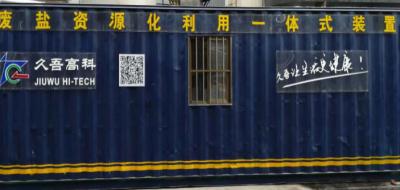
Compared with traditional scrubbers, the ceramic membrane nano-desulfurization separation technology uses ceramic nanofiltration tubes as the desulfurization carrier, and sodium hydroxide as the reaction agent, which can be recycled to meet the requirement that the sulfur oxide content in the exhaust gas is not higher than 0.1%, and there is no waste water discharge in the whole process, so it is the only product on the market without any waste water discharge.
The ceramic membrane nano desulfurization separation system is a modular design, which is easy to be flexibly arranged according to the platform structure and easy to install. The overall energy consumption of the system is 0.6% to 0.8% of the ship’s electrical load. The energy consumption is relatively low compared to similar products on the market. The volume is reduced by 50%, but the energy efficiency is increased by 30%. What's more convenient is that the refitted ship project does not need to enter the dock, and the lifting height and weight requirements of the dock crane are not high, and the general shipyard can meet the requirements.
Ceramic membrane technology can permeate sulfur dioxide in the exhaust gas of ship engines and then absorb it with lye. The engine exhaust gas has a certain temperature, so ceramic membranes are currently used in this field. In addition, nitrogen oxides and dust in ship exhaust can be treated with membrane technology.

 +86-25-58849045
+86-25-58749295
+86-25-58849045
+86-25-58749295
 jiuwu@jiuwu.com
 No. 9 Park Road, Pukou District, Nanjing City (Sanqiao Factory)



 Call us on:
  Email Us:
  No. 9 Park Road, Pukou District, Nanjing City (Sanqiao Factory)
 English
 한국어
한국어 français
 русский
 Español